

Academic Return on Investment (ROI)
How do you know which programs are having the greatest impact on student outcomes?
School leaders make decisions every day about how to best allocate community resources to ensure all students receive a high-quality education. Documenting the impact of programmatic investments is the essence of evidence-based practice.
Academic return on investment (ROI) is an analytic approach that quantifies the impact of a particular program or intervention on student growth.
Asking the Right Question
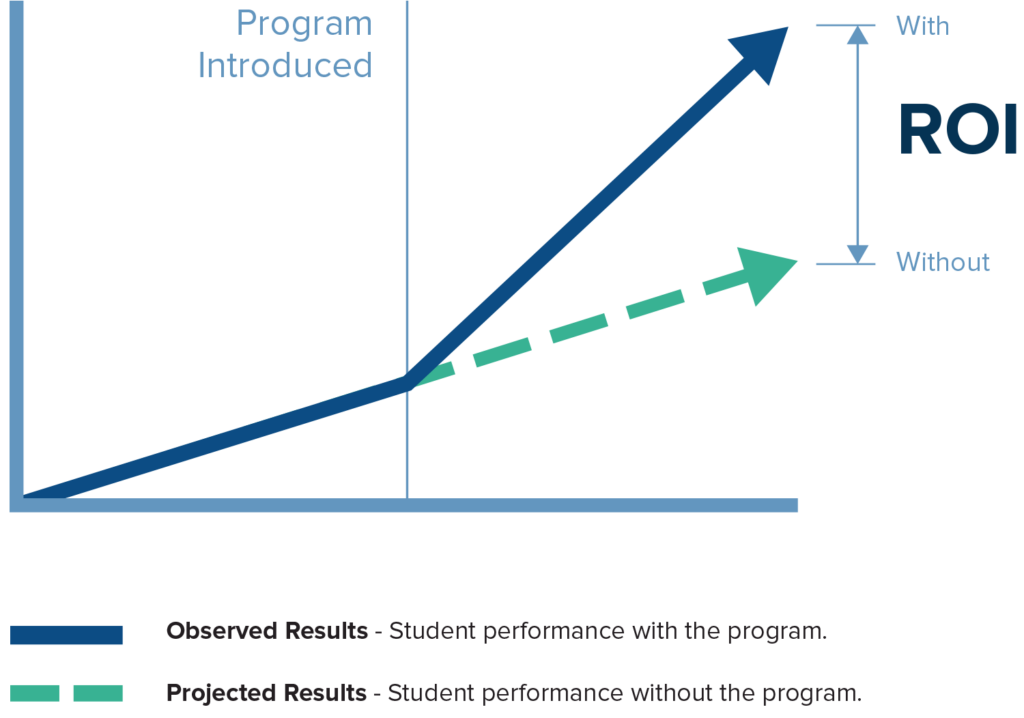
The key insight that motivates academic ROI is recognizing that students will continue to grow with or without a particular investment. Academic ROI quantifies the impact of an investment on student growth above and beyond growth that would have happened anyway.
Districts often ask: “How did students in the program grow?”
Academic ROI asks: “How did students in the program grow compared to how they would have grown without the program?”
An In-Depth Look at Academic Return on Investment (ROI)
Academic ROI is measured by comparing student growth as a result of a particular program to student growth without the program. Learn the process of measuring academic ROI and how to leverage predictive models to quantify the impact that specific programs have on student learning.
The Process of Academic ROI
Academic ROI uses a disciplined method of inquiry that leverages the scientific method.
1. Invest
Our district invested $1.5 million into a reading program to accelerate rates of growth for struggling readers.
2. Question
Are students served by the program growing faster than they would have grown without the program?
3. Evaluate
Create a personalized growth projection for each student assuming the program did not exist. Then, compare observed growth for each student with the program to projected growth without the program.
4. Act
Validate program effectiveness, use results to improve the program, or consider reallocating resources to more effective programming.
ECRA’s ROI Methodology
ECRA analyzes an individual student’s longitudinal growth trajectory, and the trajectory of similar students to create a personalized projection for each student. The projection represents where a student would likely perform without the program. We then measure the distance between observed performance with the program to projected performance without the program.
Reporting Results
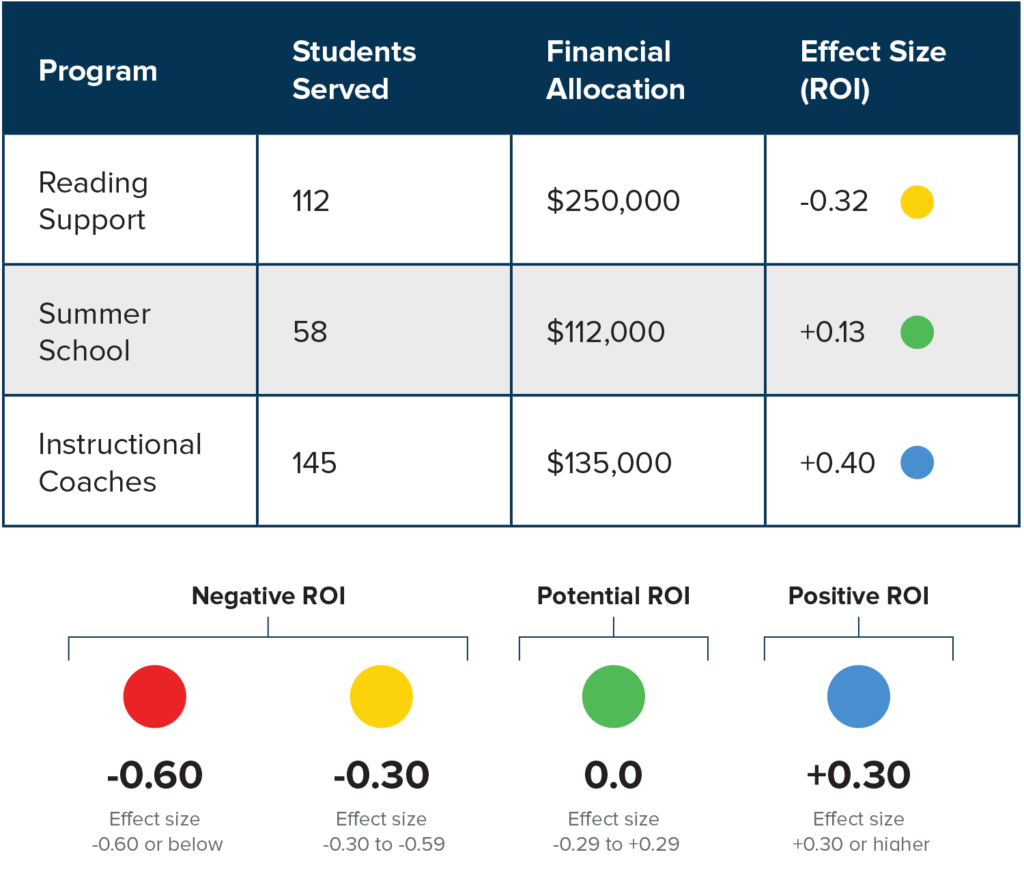
ECRA reports academic ROI using the metric of effect size. We categorize effect sizes using well established research-based thresholds to aid interpretation.
Imagine evaluating every program and intervention every year for academic ROI. Over time, ensure investments are directed towards programs with positive ROI.
Academic Return on Investment Connects Resources to Results
ECRA’s Academic Return on Investment feature helps district leaders understand which programs, strategies, and investments are making the greatest impact on student outcomes. By connecting resource allocation to measurable results, districts can make evidence-based decisions that strengthen improvement efforts and support long-term success.
What is Academic Return on Investment?
Academic Return on Investment helps district leaders understand how programs, initiatives, and resources are connected to student outcomes. It provides a clearer view of what is working, where investments are making an impact, and where adjustments may be needed.
How does Academic Return on Investment support school improvement?
Academic Return on Investment gives teams evidence they can use to evaluate the impact of key strategies within ECRA’s School Improvement solution. This helps districts focus time, funding, and attention on the actions most likely to improve student outcomes.
Why is Academic Return on Investment important for district leaders?
District leaders are asked to make difficult decisions with limited resources. Academic Return on Investment helps leaders move beyond assumptions by using evidence to guide decisions about programs, staffing, interventions, and strategic priorities.
What types of questions can Academic Return on Investment help answer?
Academic Return on Investment can help leaders explore questions such as which initiatives are producing results, which student groups are benefiting, and whether resources are aligned to the district’s improvement goals.
How does ECRA make Academic Return on Investment easy to understand?
ECRA turns complex data into clear, actionable insights that district and school leaders can use with confidence. The goal is to make analysis accessible, practical, and useful for decision-making, planning, and communication.
